
When a farmer described a struggling sapling as “your tree”, Dr. Prakash Bhat, advisor to Thryve, heard something important. The tree stood on the farmer’s land, and the farmer had planted it, but he still associated it with the organisation that had supplied it. Planting had happened; a sense of ownership had yet to follow.
That memory captures a central lesson from our conversation with Dr. Bhat: the future of a tree depends on the relationship people build with it.
A veterinarian and rural development practitioner based in Dharwad, Karnataka, Dr. Bhat brings more than 40 years of experience to the field. His work on the orchard-based Wadi approach, associated with BAIF, brought together community organisation, water conservation, and integrated farming. Speaking with Thryve, he reflected on what helps agroforestry take root, why some efforts fall short, and what practitioners should carry forward.
Understanding the wadi model
Our discussion began with the concept of Wadi, meaning 'orchard', and how it has evolved into a holistic approach to farming. Dr. Bhat described how his work in Karnataka grew into an integrated farming system linking trees, fruit crops, fodder, livestock, soil and water conservation, and vermicomposting. Fruit trees gave produce; other trees supplied fodder, mulch and manure.
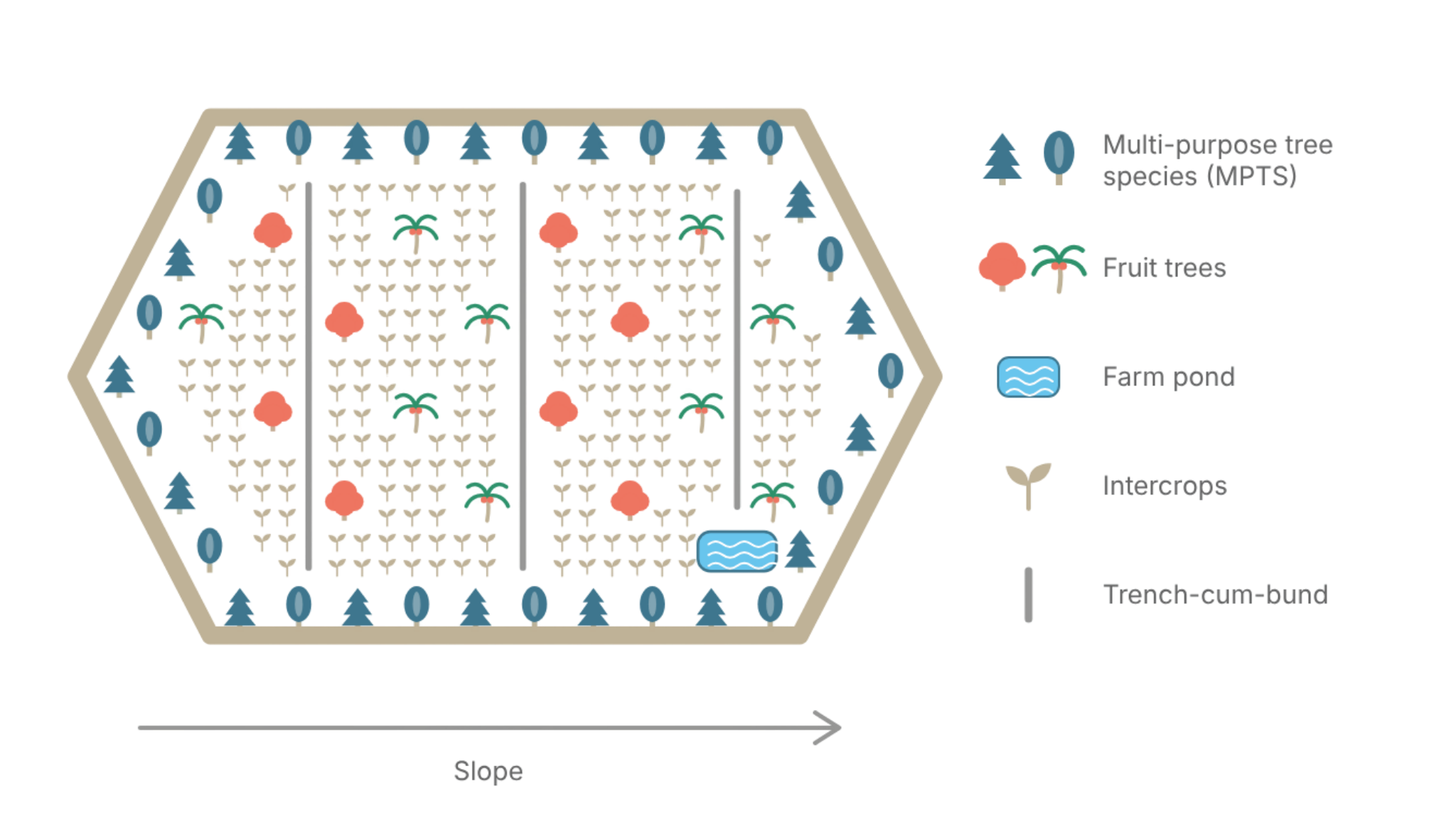
The design reflected this. Trees went on the farm boundary in two staggered rows along a trench. Timber species such as teak, which farmers asked for, grew tall, while biomass species between them were cut at chest height for fodder, mulch and manure.
Preparation began before a sapling arrived. On marginal upland plots, trenches and bunds held back rainfall and soil. Many families depended on wage labour elsewhere, so the programme covered roughly 50 to 60 per cent of the labour cost, but not all of it, since he felt paying in full for work on a farmer’s own field was unwise. A technically sound design has to account for the time, labour and income a household can realistically commit.
Trust grows through other farmers
How do you persuade someone to plant trees whose benefits take years to arrive? In Dr. Bhat’s experience, visits to other farmers worked best. His team took participants to meet small and marginal farmers who had already built similar systems. He said,
No amount of just talking could have achieved that.
Seeing a working farm and speaking with someone in similar circumstances made the possibilities easier to judge. Weekly self-help groups of 15 to 20 people, with men’s and women’s groups equally represented, kept the conversation going. Farmers discussed choices and difficulties together, and decisions on who received which plants were made in the group. Some farmers were ready to try immediately; others waited to see results nearby. Hesitation was understandable among people with reason to be wary of outsiders.
His advice to field teams was to arrive with humility and patience. Working with a community means accepting questions, disagreement and the time it takes to earn confidence.
Make planting part of community life
Dr. Bhat wanted planting to be something communities could organise and celebrate. His team organised and ran a community event, Hassu Habba, or “green festivals”, in which people from many villages joined and gathered together to plant trees and celebrate them. He recalled,
Planting is celebration. Planting is working together.
Nursery work opened another route into participation. The programme trained local women to raise seedlings, then bought those seedlings from them, giving them an income of their own. His idea of success followed: people gaining the confidence and capacity to organise, decide and carry work forward themselves.
Plan for survival and keep learning
Dr. Bhat was candid about the difficulties. Planting competed with farm work in the monsoon, some pits were poorly prepared, and grazing protection was uneven. In his recollection, survival reached 50 to 60 percent at best, and stayed above 50 per cent overall even through three drought years in the early 2000s. Planting after July cut survival sharply, so nurseries had to be planned backwards from the planting season.
He also questioned his own choices. In his enthusiasm for forestry, he planted too many trees; for boundary planting he would now suggest around 200 per acre, better planting material and more farmer involvement in species selection. Farmers know their needs and their land, and practitioners can introduce options they may not know. Being consulted is what lets a farmer see a tree as theirs.
Years later, he has found trees still standing and families who remember the improvements.
Bringing these lessons into today’s agroforestry programmes
For Thryve, Dr. Bhat’s advice was concrete:
- Start planning the next season early, select farmers and take their species preferences.
- Pair technical guidance with farmer choice, and build skills through hands-on training.
- Help local partners combine technical competence with community engagement.
He saw promise in carbon finance as a way to support planting and farmer livelihoods, conditional on finance materialising and reaching its intended purpose. His underlying point is that the environment is the base of development. Soil, water, trees and animals are what farming depends on, and agroforestry can bring them together when its design reflects both the landscape and the people managing it.
The farmer’s phrase, “your tree”, returns us to the challenge. A sapling can be supplied in a day. Building the knowledge, trust and sense of ownership that sustain it takes longer. For Dr. Bhat, that work belongs at the centre of any agroforestry program.
Learn more about our approach in detail - here.



Download PDF


Gallery
You might also like...


Ingin bermitra dengan kami?

